loader

color options

Logo for librecounter
+48 516 385 392
info@369sortwaste.pl

Mini blog about recycling


Water: The 369 Paradigm and Ecosystem Architecture
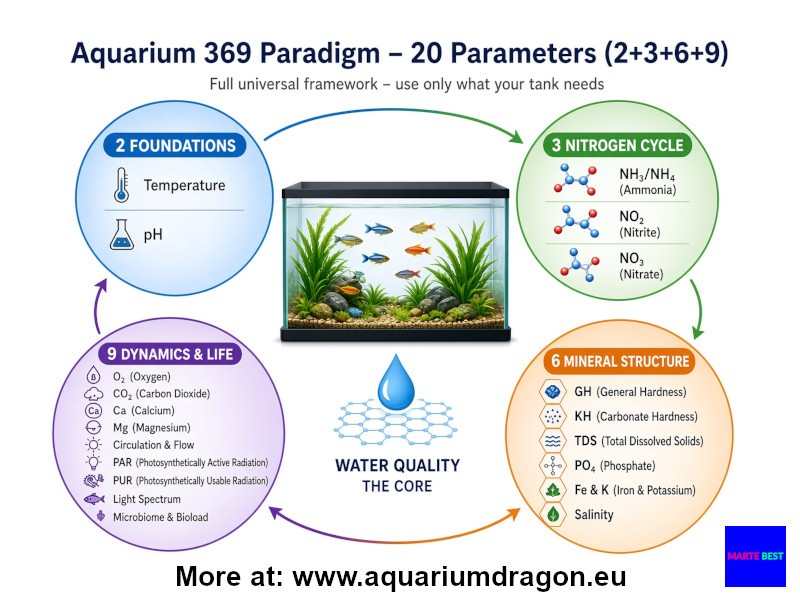
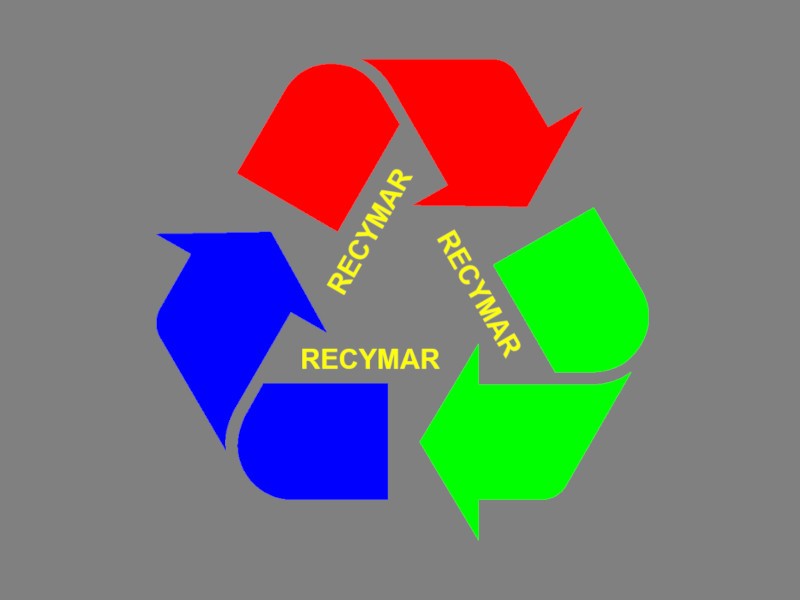
Aquaristics is a field that allows us to observe, on a micro-scale, the powerful processes governing the entire universe. Clean water, essential for the lives of our fish and plants, is not just a simple chemical compound. It conceals a deep mathematical and geometric order that fits the 369 Paradigm.The system in the 369 Sort Waste campaign is based on 20 segregation fractions (18 colored fractions and 2 base fractions: black and white). This number – 20 – closes a perfect cycle of matter. Managing a mature, stabilized aquarium ecosystem is guided by the same complete framework of exactly 20 interconnected parameters, arranged as 2, 3, 6 and 9. These reflect the physicochemical and geometric properties of water itself.
Just as in 369 Sort Waste, the full set of 20 is the ideal closed loop — yet not every parameter must be used every day. Aquarists apply only what their specific tank needs.
Block 1: Foundations (Number 2)
The number 2 symbolizes dualism and polarity in nature. The water molecule (H₂O) is a dipole. In the 369 Sort Waste concept these are the 2 base fractions (black and white). In an aquarium they are the two overriding parameters that define the physical environment.
  1. Temperature (Kinetic energy): Determines dissolved-gas capacity and regulates the metabolism of cold-blooded animals. The physical foundation of life.
  2. pH (Water acidity): Results from the polarity and dissociation of water. The chemical switch that decides whether substances are absorbable or toxic.
Block 2: Biology and the Nitrogen Cycle (Number 3)
The number 3 is the triple point of water. In aquaristics it symbolizes the closed Nitrogen Cycle — the biological engine of waste processing that mirrors recycling.
  1. NH₃/NH₄ (Ammonia / Ammonium): The first, highly toxic stage of waste.
  2. NO₂ (Nitrites): The transitional, still poisonous stage produced by Nitrosomonas.
  3. NO₃ (Nitrates): The final, relatively safe stage produced by Nitrobacter; a valuable fertilizer for plants.
Block 3: Mineral Structure (Number 6)
The number 6 reflects the hexagonal structure of water clusters and ice crystals. These six parameters form the crystalline scaffolding of the water — hardness, dissolved matter and the mineral resources that build organic mass.
  1. GH (General Hardness): Sum of calcium and magnesium salts; maintains osmotic balance.
  2. KH (Carbonate Hardness): Buffer capacity that protects against sudden pH swings.
  3. TDS (Total Dissolved Solids): Overall density of dissolved matter.
  4. PO₄ (Phosphates): Essential macro-element for energy (ATP) and growth.
  5. Fe & K (Iron & Potassium): Iron drives chlorophyll; potassium activates enzymes and water management in plants.
  6. Salinity: Salt content / specific gravity — the universal bridge that makes the framework valid for both freshwater and marine systems.
Block 4: Dynamics and Expansion of Life (Number 9)
The number 9 symbolizes closure, the density anomaly of water, and the highest complexity. These nine parameters supply the vital forces, energy and interactions that give the system three-dimensional life.
  1. O₂ (Dissolved Oxygen): Breath of the ecosystem and fuel for aerobic bacteria.
  2. CO₂ (Carbon Dioxide): Building block of organic carbon for plants.
  3. Ca (Calcium): Essential for cell division, tissue growth and skeletal structures.
  4. Mg (Magnesium): Central atom of the chlorophyll molecule.
  5. Circulation & Flow: Prevents anaerobic dead zones and distributes nutrients.
  6. PAR (Photosynthetically Active Radiation): Total quantity and density of photons.
  7. PUR (Photosynthetically Usable Radiation): The specific wavelengths actually usable by plants and corals.
  8. Light Spectrum: Quality and color distribution of the light (Kelvin / nanometers).
  9. Microbiome & Bioload: Bacterial biodiversity plus the total metabolic load of all animals; the final balance point of the entire system.
Conclusion and Summary
The sum of these parameters is 20. In the 369 Sort Waste philosophy this number represents ultimate order (18 colors + 2 extremes).

An aquarist maintains harmony among these 20 factors so the miniature glass world does not drown in toxins; humanity can apply the same 20-fraction logic so our blue planet keeps its capacity for self-regeneration. The full framework is always available; every aquarist (and every household) simply uses the layers that are needed. Aquaristics and advanced waste recycling tell the same story — closing the loop, protecting water quality, and imitating the perfect mathematics of nature contained in the code 3, 6 and 9. Explore the complete system at 369sortwaste.pl and 369sortwaste.com.
Written by Sylwester Bogusiak
O mnie: Programista, akwarysta, ekonomista, badacz, matematyk, filozof. Zamiłowanie do liczb i matematyki oraz komputerów zaszczepił u siebie wraz z obejrzeniem seansu Kaszpirowskiego w wieku 11 lat. Pierwsze co poznał - to to, że dobre jest mleko matki, a inne nie - czyli system binarny miał już opanowany w wieku niemowlęcym. Autor serwisu dla akwarystów www.akwa-market.pl i strony o pieniądzu i bankowości www.positivemoney.pl oraz założyciel kampanii 369 SORTUJ ODPADY.
Postaw mi kawę na buycoffee.to
Related posts
POST